The Declassified Dossier on Decaf: Is It All It’s Cracked Up to Be?
You’re on watch. It’s 0200 (2 am), the world is quiet, and the only thing keeping your eyes open is the steady supply of dark, hot coffee in your mug. At Watch Call Coffee, we get that. We built our brand on providing the high-quality, robust coffee you need to stay vigilant.
But what about when the watch is over?
We’ve all been there. You’re coming off a long shift, you want the taste and comfort of a good cup of coffee, but you actually need to sleep. You’ve got to be rested and ready for the next call, the next shift, the next emergency. This is where the dreaded “D-word” comes in: Decaf.
For a lot of us, “decaf” feels like a dirty word. It’s the coffee equivalent of a non-alcoholic beer or a dull knife. We have this idea of it being a weak, flavorless, chemical-filled imposter. But is that fair?
We’re not going to lie to you—we don’t currently carry a decaf. Our mission has always been to source and roast the most robust, flavorful, and high-quality coffee possible. Frankly, most decaf we’ve tasted just doesn’t make the cut.
But we’re also big believers in “eyes open, full-auto learning.” If we’re going to dismiss something, we should at least know why. And if we’re ever going to consider offering one, it would have to be the best of the best.
So, we did a deep dive. We put on our investigator hats and pulled the full dossier on how exactly the caffeine gets “interrogated” out of a coffee bean. The truth is… it’s a fascinating, and sometimes controversial, world of science.
If you’ve ever wondered what you’re really drinking when you order a decaf, consider this your operational briefing.
First Things First: How Decaf is Born
Here’s the first fact that blows most people’s minds: Coffee is decaffeinated when it’s still green.
That’s right. The process doesn’t happen after roasting. It happens when the beans are raw, green, and hard as pebbles. The goal of every decaffeination method is the same: get the caffeine out while leaving all the other good stuff (the oils, acids, and compounds that become “flavor” when roasted) behind.
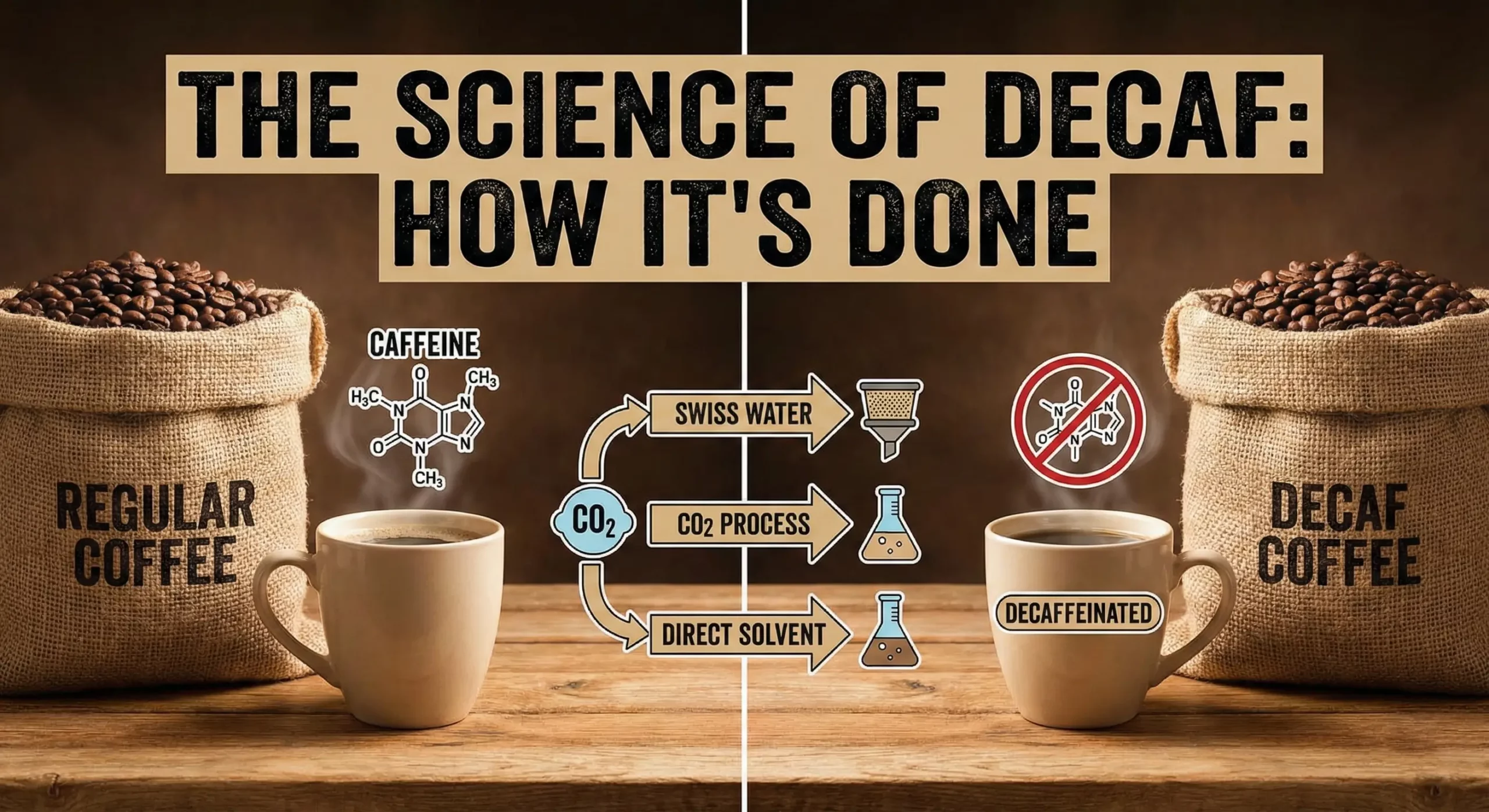
By law, to be called “decaf” in the United States, a bean has to have 97% of its original caffeine content removed. Here are the four primary methods used to make that happen.
Method 1: The “Old School” Solvent Method (Methylene Chloride) for Decaf
This is the one you’ve probably heard whispers about. It’s the most common, oldest, and most controversial method. It uses a chemical solvent called Methylene Chloride (MC) to strip the caffeine.
How It Works:
- Steam: The green beans are first steamed or soaked in hot water to open up their “pores,” making the caffeine accessible.
- Soak: The beans are then soaked in Methylene Chloride. The MC molecules are like a specialized extraction team—they bond only with the caffeine molecules, leaving the larger flavor compounds alone.
- Evaporate: The caffeine-rich solvent is drained away.
- Repeat & Rinse: The beans are steamed again for several hours to evaporate any and all residual solvent, long before they ever see a roaster.
The Intel:
- Pros:
- Flavor Preservation: This method is surprisingly good at its job. Because MC is so selective, it does an excellent job of retaining the bean’s original flavor oils. Many coffee pros will tell you MC decaf often tastes the best.
- Cost-Effective: It’s a relatively cheap and efficient process, which is why it’s so common.
- Cons:
- The “Chemical” Stigma: The name says it all. Methylene Chloride is a chemical also used in things like paint strippers. That’s a PR nightmare, and it’s enough to make anyone pause.
The Health & Safety Briefing:
This is the big question. Is it safe?
According to the FDA, yes, overwhelmingly so. The regulations are incredibly strict. The FDA allows up to 10 parts per million (ppm) of residual MC. In practice, the decaffeination process is so thorough (and involves so much steam) that most beans end up with non-detectable levels, closer to 0.1 ppm.
Then, you have to remember: we roast this coffee at over 400°F. Methylene Chloride evaporates at 104°F. Any microscopic trace that could have possibly remained is completely obliterated in the roaster. You are in zero danger of consuming this chemical. The “con” here isn’t about health; it’s about the idea of it.
Method 2: The “Natural” Solvent Method (Ethyl Acetate / “Sugarcane”)
Because “Methylene Chloride” sounds scary, the industry found a solvent that sounds much friendlier: Ethyl Acetate (EA). This is often marketed as the “Sugarcane Process” or “Natural Decaf.”
How It Works:
This process is usually “indirect.”
- Soak: The green beans are soaked in hot water, which leaches everything out—caffeine, flavor, oils. The beans are set aside.
- Extract: This “flavor-rich” water is moved to a separate tank. Ethyl Acetate is added to the water. The EA bonds with the caffeine, and the resulting EA-caffeine compound is skimmed off the top.
- Re-Soak: The now caffeine-free, but still flavor-rich, water is returned to the original green beans, which re-absorb all their flavor compounds.
The Intel:
- Pros:
- Great Marketing: Ethyl Acetate is a compound found naturally in ripening fruit, like bananas and pears. It can also be synthesized from sugarcane, which is where the “Sugarcane Process” name comes from. It just feels safer and more natural.
- Cons:
- Potential for “Fruity” Flavor: This process is tricky. If not done perfectly, it can leave a slight, sweet, almost wine-like “fruity” flavor in the finished cup. For a purist, this is a deal-breaker.
- “Natural” is Relative: While EA can be derived from sugarcane, it’s often synthesized in a lab just like other chemicals. It’s the same base compound used in nail polish remover. Again, this isn’t a safety issue—it’s a marketing one.
The Health & Safety Briefing:
Just like with MC, this process is considered perfectly safe. The EA is completely removed, and any remaining trace is vaporized in the roaster. The “health benefit” is purely psychological—you get to drink a decaf that wasn’t processed with something that sounds like it belongs in a hardware store.
Method 3: The “Pure Water” Method (Swiss Water Process)
This is the one you see advertised on high-end, organic coffee bags. The Swiss Water Process (SWP) is famous for one thing: it uses zero chemicals, ever.
How It Works:
This process is pure, brilliant, and a little confusing. Bear with us.
- Create “Flavor-Charged Water”: First, they take a batch of green beans and soak them in pure hot water until all the soluble compounds (caffeine and flavor) are leached out. This first batch of beans is now useless and is discarded.
- Filter the Caffeine: This water—which they call “Green Coffee Extract” (GCE)—is then passed through a series of activated carbon (charcoal) filters. These filters are specially designed to trap only the large caffeine molecules, while letting the smaller flavor molecules pass through.
- The “Magic” Step: Now, they have a tank of GCE that is 100% caffeine-free but completely saturated with all the original flavor compounds.
- The Real Decaf Batch: A new batch of fresh green beans is soaked in this GCE. Because the water is already full of flavor, it can’t absorb any more flavor from the new beans. It’s a “flavor-neutral” bath. However, the water is empty of caffeine. Through simple osmosis, the caffeine molecules migrate out of the beans and into the water, until the beans are 99.9% caffeine-free.
The Intel:
- Pros:
- 100% Chemical-Free: Its biggest selling point. It’s just water, osmosis, and charcoal.
- Organic Certified: This is the only process that can be used on beans that will be certified Organic.
- Cons:
- Expensive: This process is patented, complex, and time-consuming. That cost is passed on to you.
- Flavor Impact: This is debatable, but some coffee pros argue the SWP is a bit of a “blunt instrument.” While it doesn’t add any off flavors, the intense water-logging can sometimes wash away some of the bean’s more delicate, bright, and acidic top notes, resulting in a cup that’s a bit flatter or more “basic.”
- Water Waste: It uses an enormous amount of water.
The Health & Safety Briefing:
It doesn’t get cleaner than this. If your primary concern is consuming anything “unnatural,” this is your gold standard. There are zero health concerns, full stop.
Method 4: The “High-Tech” Method (Supercritical CO2)
This is the newest, most expensive, and arguably most “sci-fi” method of them all. It uses Carbon Dioxide (the same stuff we carbonate water with) to pull out the caffeine.
How It Works:
- Soak: The green beans are soaked in water to open their pores.
- Pressurize: The beans are put into a massive, high-pressure vessel (like a submarine). Liquid CO2 is pumped in and held at about 1,000 pounds per square inch.
- “Supercritical” State: At this specific pressure and temperature, the CO2 becomes “supercritical.” It’s not a liquid, and it’s not a gas. It’s a special state where it flows like a gas but has the dissolving power of a liquid.
- Targeted Extraction: In this state, CO2 is an extremely selective solvent for caffeine. It infiltrates the beans, bonds only with the caffeine, and leaves all the flavor compounds untouched.
- Release & Recycle: The caffeine-filled CO2 is pumped into a separate chamber. The pressure is released, the CO2 turns back into a regular gas, and it simply floats away, leaving the dry, raw caffeine powder behind. The CO2 is then captured, re-pressurized, and used for the next batch.
The Intel:
- Pros:
- Exceptional Flavor: This is arguably the best method for preserving the bean’s original, unique flavor profile. It is incredibly gentle and selective.
- 100% “Natural”: It uses only water and CO2.
- Environmentally Sound: The CO2 is 100% recycled in a closed-loop system.
- Cons:
- Insanely Expensive: This process requires what is essentially a small industrial factory. The capital investment is massive, making this the most expensive decaffeination method on the planet. It’s usually reserved for massive, commercial-scale coffee operations.
The Health & Safety Briefing:
Perfectly safe. It’s just CO2 and water. There is no residue, no chemicals, and no health concerns.
Our Final Verdict
So, is decaf coffee a weak imposter?
Not necessarily. It turns out that “decaf” isn’t one single thing. It’s a result of a complex process, and that process matters. A decaf that’s been processed with high-tech CO2 is a completely different product from one processed with Methylene Chloride or Swiss Water.
At Watch Call Coffee, our standard is, and always will be, uncompromising quality. We’re not in the business of selling you something that’s “just okay.” We’re here to provide the absolute best coffee to see you through.
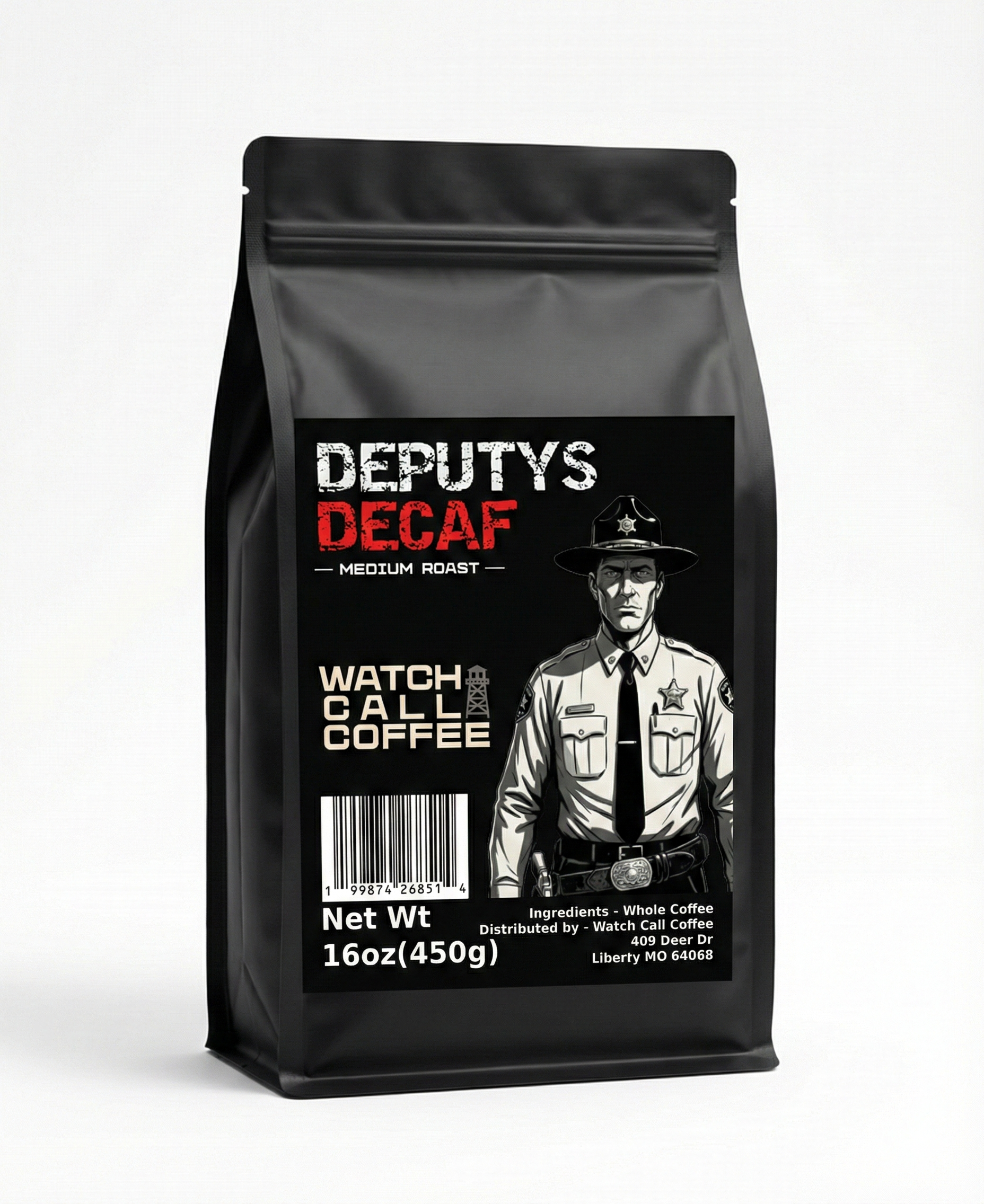
This is why we’ve held off. Until now! We have just developed our first decaf Coffee, Deputy’s Decaf! This is a medium roast and decaffeinated using the Swiss Water Process, so no chemicals.
Deputys Decaf
Sometimes the best part of the watch is winding down. Deputy's Decaf delivers the rich, comforting experience of a premium brew without the extra jolt, making it the perfect companion for late shifts or a relaxing evening off-duty.
If we can’t find a decaffeinated bean that still has the character, the body, and the incredible flavor you expect from us, we simply won’t put our name on it.
But this has us thinking. We’ve laid out the intel, and now we’re turning the question over to you, our community.
We’re curious what you think. Is a high-quality, “no-compromise” decaf something you’d want to see in the Watch Call Coffee lineup for those off-duty hours?
Let us know your thoughts. And in the meantime…
Stay vigilant.