Ever Wonder Where Your Coffee Actually Comes From? Coffee is not complicated.
Let’s be honest. You grab your coffee every morning. You know you like it. You might even love it. But when you look at a bag of beans in the store, it feels… complicated.
“Single-Origin.” “Washed Process.” “Bourbon Varietal.” “Grown at “3,600ft.”
It’s enough to make you just grab the bag you always get and walk away. It feels like you need a science degree to just buy a good cup of coffee.
Here’s the good news: coffee isn’t that complicated.
It’s a fruit. Grown on a tree. By people. That’s it. And understanding just a little bit about its journey from a farm to your cup doesn’t just make you sound smart—it empowers you. It helps you find coffee you love and appreciate every sip just a little bit more.
So let’s pull back the curtain. Forget the confusing jargon. Let’s talk about where your coffee really comes from.
📍 It All Starts With… Geography? Welcome to the “Coffee Belt”
First things first: coffee is a total diva. It’s incredibly picky about where it lives.
You can’t just plant a coffee tree in your backyard in Ohio or New York and expect to harvest beans. Coffee plants need a “Goldilocks” environment: not too hot, not too cold, and definitely no frost.
This perfect environment exists in a band that wraps around the middle of the globe, neatly tucked between the Tropic of Cancer and the Tropic of Capricorn. We call this “The Coffee Belt.”
This region—which covers parts of Central and South America, Africa, and Asia—has the magic combination:
- Rich, often volcanic, soil.
- Stable, warm-but-not-scorching temperatures.
- Plenty of rainfall followed by a distinct dry season (which is crucial for harvesting).
Even within the belt, altitude is king. Higher-altitude farms (think 3,900 ft) have cooler nights, which slows down the cherry’s ripening process. This extra time allows more complex sugars and acids to develop in the bean.
Your Takeaway: Location is the first ingredient. A coffee grown high in the mountains of Colombia will taste completely different from one grown in the lower-lying fields of Brazil, even if it’s the same type of plant.
🌱 The Surprisingly Long Journey of a Coffee Cherry
When you buy a bag of corn, you know it was planted and harvested in the same year. Coffee is a completely different game. Growing coffee isn’t a sprint; it’s a multi-year marathon.
This is the part most of us never think about, but it’s where the farmer’s hard work truly begins.
- The Seedling: A coffee “bean” (the green, unroasted thing) is actually a seed. Farmers plant these seeds in shaded nurseries where they grow into tiny seedlings for 6-12 months, protected like a newborn.
- The Big Move: Once they’re strong enough, they’re planted in the main field.
- The Long Wait: This is the tough part. The new coffee tree will not produce any fruit for 3 to 5 years. Think about that. A farmer has to invest water, land, and labor for years before seeing a single cherry.
- The Flower: After a good, heavy rain, the coffee trees burst into bloom. The branches are covered in small, white flowers that smell intensely like jasmine. It’s supposedly one of the most beautiful sights (and smells) in the agricultural world.
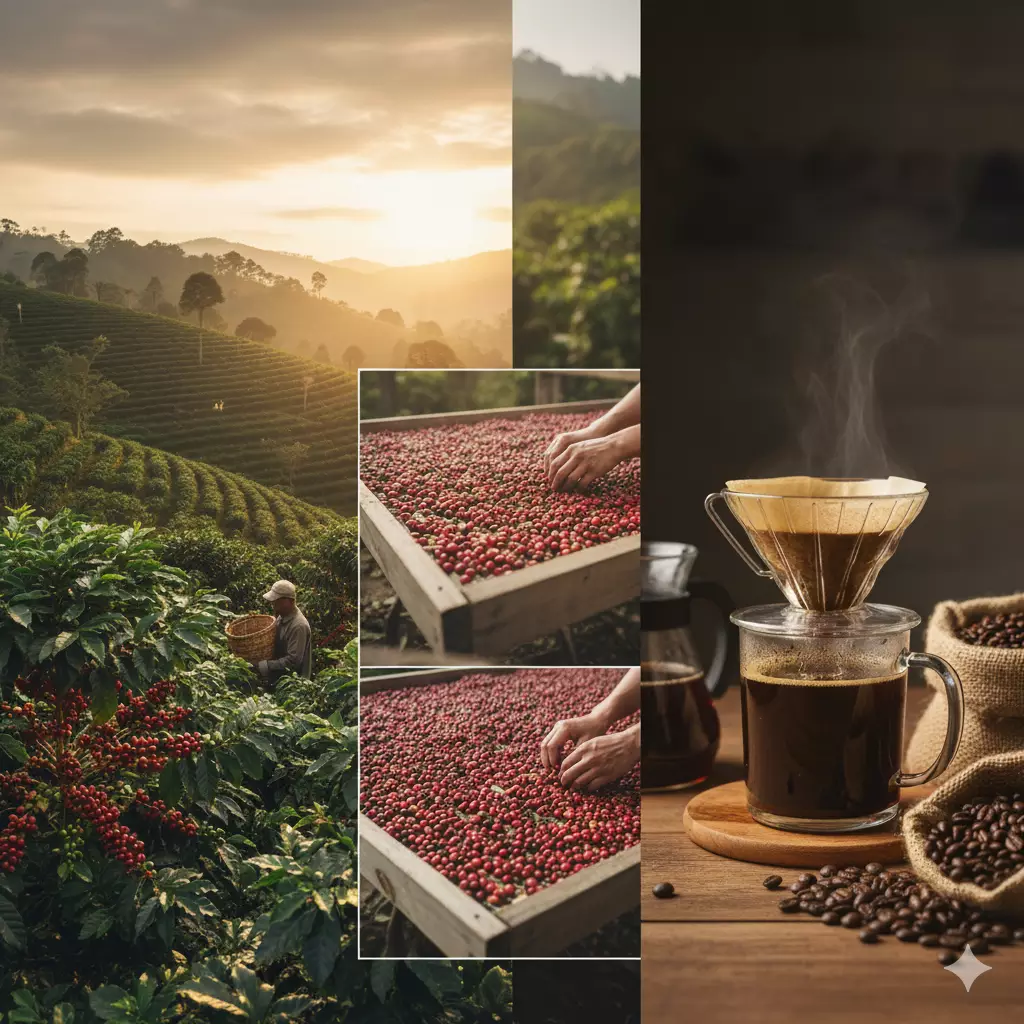
- The Cherry: Each flower is pollinated and, over the next nine months (sound familiar?), slowly ripens into a coffee cherry. The cherry starts green, turns yellow, and finally becomes a deep, glossy red (or sometimes bright yellow) when it’s perfectly ripe and full of sugar.
- The Harvest: This is where the magic really happens. Most specialty coffee is picked by hand. Why? Because cherries on the same branch don’t ripen at the same time. Pickers have to comb through the trees, selecting only the perfectly ripe red cherries and leaving the green ones for next time. It is back-breaking, meticulous work.
Your Takeaway: That cup of coffee you’re drinking didn’t just “happen.” It’s the end of a long, patient process that started years ago.
☕ Meet the Family: Arabica vs. Robusta
Okay, so we have coffee trees. But just like there isn’t just one kind of “apple” (think Granny Smith vs. Red Delicious), there isn’t just one kind of “coffee.”
For your purposes, you only need to know the two big players: Arabica and Robusta.
1. Arabica (The “Premium” Bean)
This is the one you see advertised on “100% Arabica” bags at the grocery store.
- Taste: This is your “specialty” bean. It’s sweeter, softer, and has more bright acidity. It’s where you get those complex tasting notes of “fruit, floral, chocolate, or berries.”
- Grown: It’s the bigger diva. It only grows at high altitudes, is more sensitive to a changing climate, and is way more susceptible to pests and disease.
- Caffeine: Contains less caffeine.
- The Bottom Line: It’s harder and more expensive to grow, but the flavor payoff is huge.
2. Robusta (The “Hardy” Bean)
This bean is named for exactly what it is: robust.
- Taste: It’s not subtle. It’s strong, often bitter or harsh, with “rubbery” or “earthy” notes. It’s not a bean you’d typically sip on its own.
- Grown: It’s a workhorse. It can grow at lower altitudes, in hotter temperatures, and produces more fruit. It’s tough as nails against disease.
- Caffeine: It packs a serious punch—about twice the caffeine of Arabica.
- The Bottom Line: You’ll find Robusta in instant coffee and as a component in traditional Italian espresso blends, where it adds a powerful kick and that thick, rich crema.
Your Takeaway: When you’re buying a bag for your home brewer, you’re almost always looking for 100% Arabica. Knowing this one thing already makes you a smarter shopper.
☀️💧 How to Get the Bean Out of the Cherry (This Changes Everything)
This is the most important part you’ve never heard of.
You’ve picked your ripe, red coffee cherry. But the part you roast is the seed (the “bean”) inside. You have to get the fruit off first.
The method a farmer chooses to do this is called “processing,” and it has a massive impact on the final taste in your cup. You see these words on bags all the time. Let’s demystify them.
1. The Natural (or “Dry”) Process: The Traditional Way
This is the oldest method in the book.
- How it works: You pick the cherry and… that’s it. You spread the entire, whole cherry out on patios or raised beds to dry in the sun, like making a giant raisin. This can take weeks.
- The Taste: While that cherry dries, the bean inside soaks up all the sugars and fruity compounds from the pulp. The result is a coffee that is big, bold, sweet, “jammy,” and heavy-bodied. You’ll get intense fruit flavors, like blueberry, strawberry, or tropical fruit.
- Find it: This is common in places with little water, like Ethiopia and parts of Brazil (Not the Amazon Rain Forest) .
2. The Washed (or “Wet”) Process: The “Clean” Way
This method is all about precision.
- How it works: Within hours of picking, the cherries are put through a “depulper” machine, which squishes the bean out of the fruit skin. The bean (still covered in a sticky fruit layer called mucilage) is then put into fermentation tanks. Good bacteria eat away the sticky stuff, and then the beans are washed completely clean before being dried.
- The Taste: Because all the fruit is removed before drying, you are tasting only the bean itself—its “origin.” The flavors are cleaner, crisper, brighter, and more acidic. This process highlights the flavors from the soil and altitude.
- Find it: This is common in places like Colombia and Kenya, where they want to showcase that bright, “classic” coffee profile.
3. The Honey (or “Pulped Natural”) Process: The Happy Medium
This is the “best of both worlds” method.
- How it works: The cherries are depulped (skin removed), but instead of being washed, they are sent straight to the drying beds with some (or all) of that sticky mucilage still clinging to the bean.
- The Taste: You get a beautiful balance. It’s sweeter and has more body than a washed coffee, but it’s cleaner and less “wild” than a natural. It’s the perfect compromise.
Your Takeaway: This is your new superpower. Don’t like sour-tasting coffee? Avoid bags that say “washed” and “bright.” Love fruity, sweet coffee? Look for “Natural Process.” Want a clean, classic cup? Look for “Washed Process.”
✈️ Why Does “Where” Matter? A World Tour of Flavor
You know how it’s grown and processed. Now for the where. Just like wine from France tastes different from wine from California, coffee’s “terroir” (its total environment) writes its flavor story.
Let’s take a quick trip.
Brazil 🇧🇷 (The Gentle Giant)
- The Vibe: Brazil is the #1 largest coffee producer in the world, by a long shot. They are the kings of coffee.
- What Makes it Unique: A lot of Brazilian coffee is grown at slightly lower altitudes and on vast, rolling hills. This allows for efficient, large-scale harvesting. They are also masters of the Natural Process (drying the cherry whole).
- What You’ll Taste: The classic “coffee-flavored-coffee.” It’s known for being low-acidity, heavy-bodied, and overwhelmingly nutty and chocolatey. Think: toasted almond, dark chocolate, and caramel. It’s the perfect base for an espresso blend or a comforting cup with milk.
Ethiopia 🇪🇹 (The Birthplace)
- The Vibe: This is where it all began. Coffee wasn’t just planted here; it grew wild. The genetic diversity is staggering.
- What Makes it Unique: Thousands of “heirloom” varieties that grow nowhere else. Processing is often done with deep, centuries-old tradition.
- What You’ll Taste: A tale of two coffees.
- Natural (Harrar): Tastes like a blueberry muffin or a strawberry bomb. In-your-face fruit.
- Washed (Yirgacheffe): Tastes like a cup of tea. It’s delicate, floral (like jasmine or bergamot), and has a bright, lemony acidity. It can completely change your definition of what coffee “is.”
Colombia 🇨🇴 (The Balanced Classic)
- The Vibe: Thanks to smart marketing (Juan Valdez, anyone?), Colombia is synonymous with quality.
- What Makes it Unique: The Andes! The mountains create thousands of tiny micro-climates, perfect for growing high-quality Arabica. They are masters of the Washed Process.
- What You’ll Taste: The definition of a balanced cup. It has a medium body, a pleasant “bright” (but not sour) acidity, and classic notes of caramel, citrus, and a nutty finish. It’s the perfect all-day, “can’t-go-wrong” coffee.
Your Takeaway: The country of origin is a cheat code for flavor. There are far more locations than just the 3 I covered, too many to list in fact.
💡 From Mystery to Mastery: Why This All Matters
So, what now?
You now know that your coffee isn’t just a generic brown powder. It’s a fruit from a specific tree (Arabica), grown in a specific place (the Coffee Belt), that took years to mature.
You know that it was likely picked by hand, and that its final taste was defined by a farmer’s choice: did they dry it as a whole fruit (Natural) for a jammy, sweet cup, or did they wash it clean (Washed) for a bright, crisp cup?
You know that the chocolatey bean from Brazil and the berry-like bean from Ethiopia are different on purpose.
This isn’t just trivia. This is how you take control.
The next time you shop for coffee, you’re not guessing anymore. You can read the label. You can see “Brazil – Natural Process” and know, “This is going to be nutty, chocolatey, and great with milk.” You can see “Ethiopia – Washed” and think, “This will be light, bright, and interesting.”
You’ve gone from being a passive consumer to an empowered, active participant in your own coffee journey.
And that, right there, makes every cup taste a whole lot better.
What’s the next step in your coffee journey? Shop our coffee, all Naturally Processed from Brazil, grown at about 3,600 ft elevation.